
Telecommunications and Information Technology Sector Witnesses Impressive Qualitative Shifts During This Flourishing Era
Since the Custodian of the Two Holy Mosques King Salman bin Abdulaziz assumed the reins of power five years ago, the telecommunications and information technology sector has witnessed impressive qualitative shifts, with which the Kingdom has advanced into the ranks of the most advanced and prosperous countries in this vital field; thanks to the significant government support it receives from the wise leadership, which has enabled the sector to continue developing and modernizing in pursuit of keeping pace with the tremendous developments constantly and continuously witnessed in this field; giving it growing importance and a prominent pivotal role in supporting the development and advancement process during this flourishing era, reflected in the classification of the telecommunications and information technology sector as one of the most important pillars of Saudi Vision 2030, working through a set of initiatives and programs to raise the level of innovation in advanced technologies, enhance the value of investment in the digital economy, strengthen the foundations of e-commerce, and enable digital government transactions in a way that contributes to achieving the goals of the Kingdom's Vision.
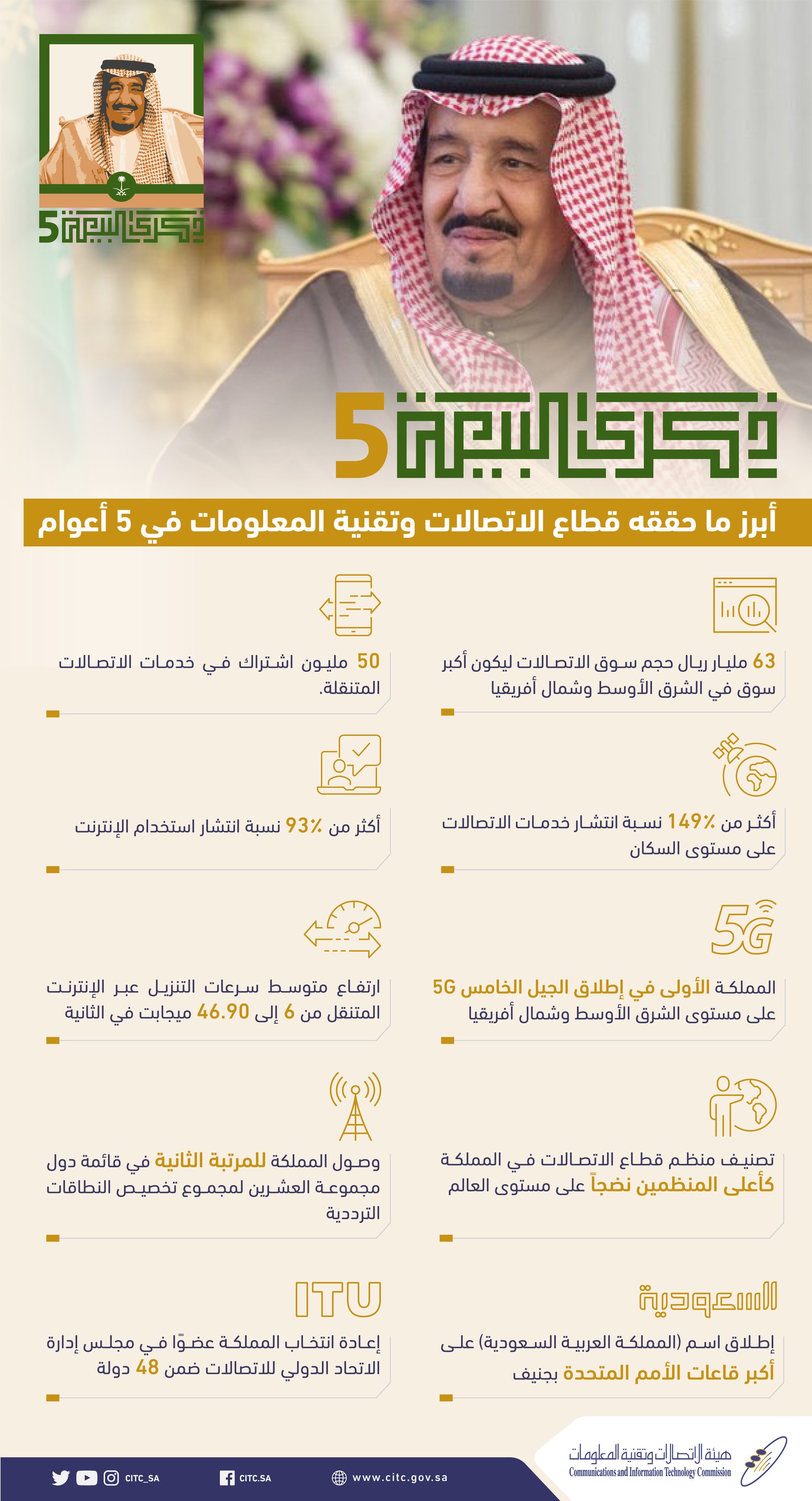
The Communications and Information Technology Commission is working to achieve these aspirations by launching a package of notable projects and initiatives, and strengthening infrastructure, including the initiative to open broadband access to fixed telecommunications networks to more than one service operator in the Kingdom, increasing the frequency spectrum allocated to service providers, enabling 5G technology, and others. These efforts were crowned by the announcement of the Kingdom's ranking in second place among G20 countries in allocating frequency bands for providing telecommunications services, after succeeding in increasing frequency spectrum allocations and raising the average mobile internet speed from 9.2 Mbps at the end of September 2017 to 43.30 Mbps by the end of August 2019, placing the Kingdom in 23rd place in internet speed worldwide according to the global Speedtest report. Internet penetration among the Kingdom's population also rose to reach 93%. The total number of mobile telecommunications service subscriptions reached 50 million, with a penetration rate exceeding 149% of the population.
This continued support and development resulted in the recording of a number of record figures, praised by the International Telecommunication Union (ITU) on more than one occasion, which was reflected in the classification of the Kingdom's telecommunications regulator among the most mature regulators in the world, in addition to naming the largest hall at the United Nations in Geneva after (the Kingdom of Saudi Arabia), and the Kingdom's re-election as a member of the ITU Council among 48 countries out of 193 member states.
This flourishing era also witnessed a remarkable growth in the market value of telecommunications and information technology services in the Kingdom, reaching (63) billion riyals, making it the largest telecommunications market in the Middle East and North Africa, in addition to establishing a head start in keeping pace with developments in the field, as the Kingdom was among the first countries to launch 5G, being the first in the Middle East and North Africa region, with the number of telecommunications towers supporting 5G technologies reaching more than 3,000 towers.
To maintain the continuity of these achievements and keep pace with the significant support the telecommunications and information technology sector receives from the wise leadership, the sector launched a comprehensive strategy, among whose most notable promising 2023 targets is contributing to GDP by no less than SAR 50 billion over five years, in addition to increasing the size of the information technology and emerging technologies market by 50%, raising the level of localization in the sector to reach 50%, creating more than 25,000 jobs, and raising women's participation in the sector by 50%.
Date
30/11/2019
Hijri Date
03/04/1441
Reading Time
0 minute