

Kingdom Strengthens Its Future Directions with Recommendations and Agreements at the Conclusion of the World Radiocommunication Conference (WRC-23)
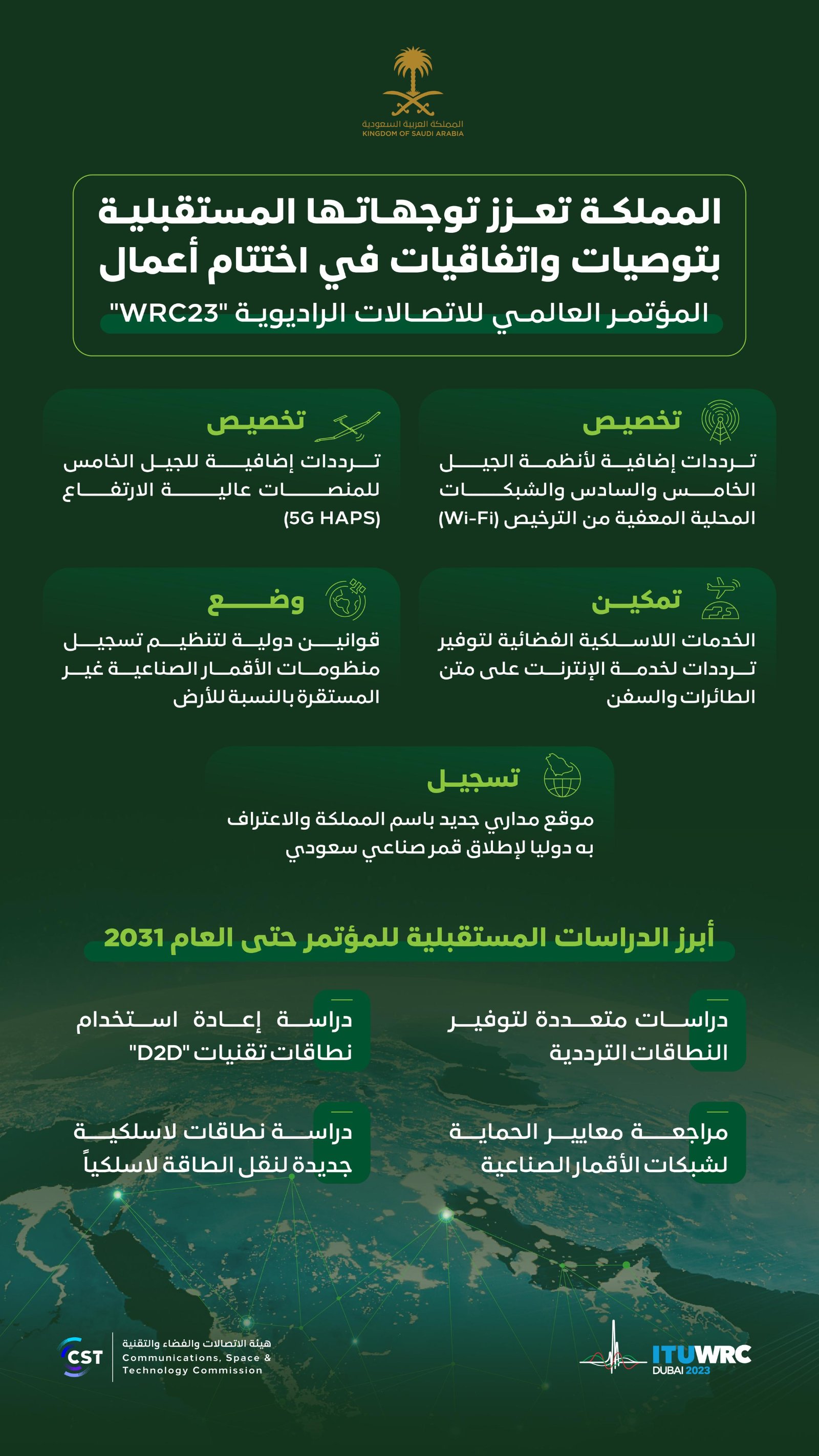
The Kingdom concluded its participation in the World Radiocommunication Conference 2023 (WRC-23), hosted by the sisterly United Arab Emirates and lasting four weeks, with His Excellency the Vice-Chairman of the Conference representing the Kingdom, Eng. Mohammed bin Abdulrahman Al-Abdulqader, explaining that the Kingdom's effective participation was crowned with the achievement of its aims of serving humanity, bridging the digital divide, and enhancing sustainability in space, and also led to numerous positive outcomes resulting in the allocation of additional frequencies for fifth- and sixth-generation systems and unlicensed local area network systems (Wi-Fi), as well as the allocation of additional 5G frequencies for High-Altitude Platform Stations (5G HAPS), for which the Kingdom conducted technical trials last year.
Al-Abdulqader stated that the Kingdom worked with the international community to enable wireless space services, including providing additional frequency bands for in-flight and onboard-ship Internet service to enhance the traveler experience, and establishing international regulations to govern the registration of non-geostationary satellite systems to support the sustainability of orbital resources, in addition to registering a new orbital position in the Kingdom's name and having it internationally recognized to support the Kingdom's plans to launch a Saudi satellite to provide broadcasting services to the Kingdom.
He noted that the conference identified a number of future topics for study during the next two sessions, extending until 2031, including studying the provision of additional frequency bands (4, 7, 8, 15) GHz and the terahertz band for fifth- and sixth-generation systems, studying the reuse of mobile satellite communications network bands for direct-to-device technologies, which will enhance global access to non-terrestrial network (NTN) technologies, reviewing protection criteria for non-geostationary satellite networks, which will contribute to the wider deployment of broadband networks, reducing their cost, and ensuring sustainability in space, in addition to studying the possibility of designating new wireless bands for wireless power transmission (WPT), which in turn serves the sustainability efforts underway in many of the Kingdom's mega-projects.
It is noted that the conference is held every four years to review the International Radio Regulations issued by the International Telecommunication Union, a United Nations agency, an international treaty governing the use of the frequency spectrum and satellite orbital resources effectively and equitably among various radio services and ensuring their coexistence. More than 4,000 participants representing 193 countries, in addition to manufacturers and operators of various wireless technologies, participated in the conference.
Al-Abdulqader stated that the Kingdom worked with the international community to enable wireless space services, including providing additional frequency bands for in-flight and onboard-ship Internet service to enhance the traveler experience, and establishing international regulations to govern the registration of non-geostationary satellite systems to support the sustainability of orbital resources, in addition to registering a new orbital position in the Kingdom's name and having it internationally recognized to support the Kingdom's plans to launch a Saudi satellite to provide broadcasting services to the Kingdom.
He noted that the conference identified a number of future topics for study during the next two sessions, extending until 2031, including studying the provision of additional frequency bands (4, 7, 8, 15) GHz and the terahertz band for fifth- and sixth-generation systems, studying the reuse of mobile satellite communications network bands for direct-to-device technologies, which will enhance global access to non-terrestrial network (NTN) technologies, reviewing protection criteria for non-geostationary satellite networks, which will contribute to the wider deployment of broadband networks, reducing their cost, and ensuring sustainability in space, in addition to studying the possibility of designating new wireless bands for wireless power transmission (WPT), which in turn serves the sustainability efforts underway in many of the Kingdom's mega-projects.
It is noted that the conference is held every four years to review the International Radio Regulations issued by the International Telecommunication Union, a United Nations agency, an international treaty governing the use of the frequency spectrum and satellite orbital resources effectively and equitably among various radio services and ensuring their coexistence. More than 4,000 participants representing 193 countries, in addition to manufacturers and operators of various wireless technologies, participated in the conference.
Date
16/12/2023
Hijri Date
3/06/1445
Reading Time
0 minute