

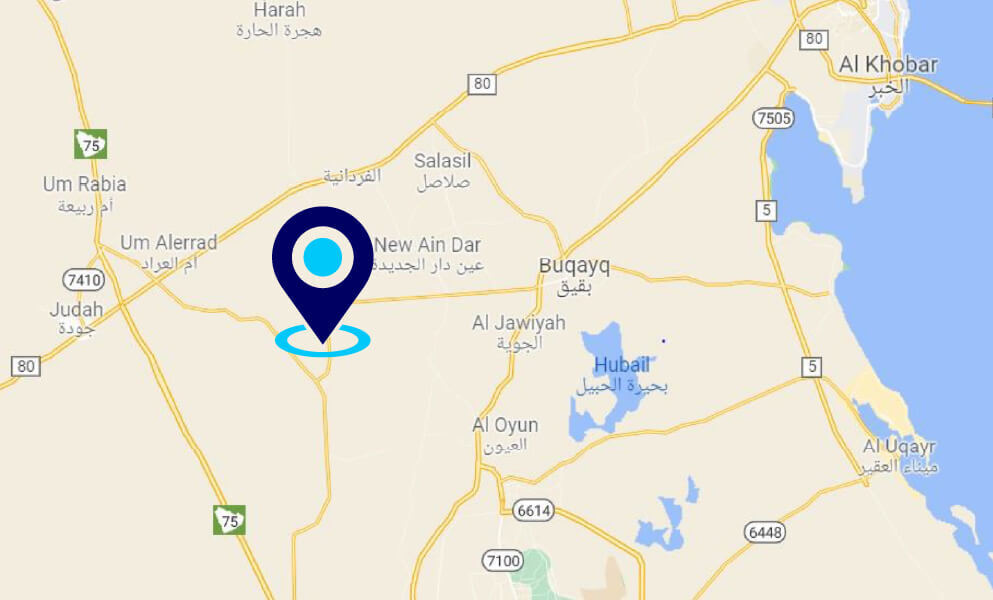
The trial was conducted in one of Aramco's remote sites located in the Ain Dar area.
The trial aims to demonstrate the potential use of Low-Earth Orbit (LEO) satellites for IoT coverage for remote area.
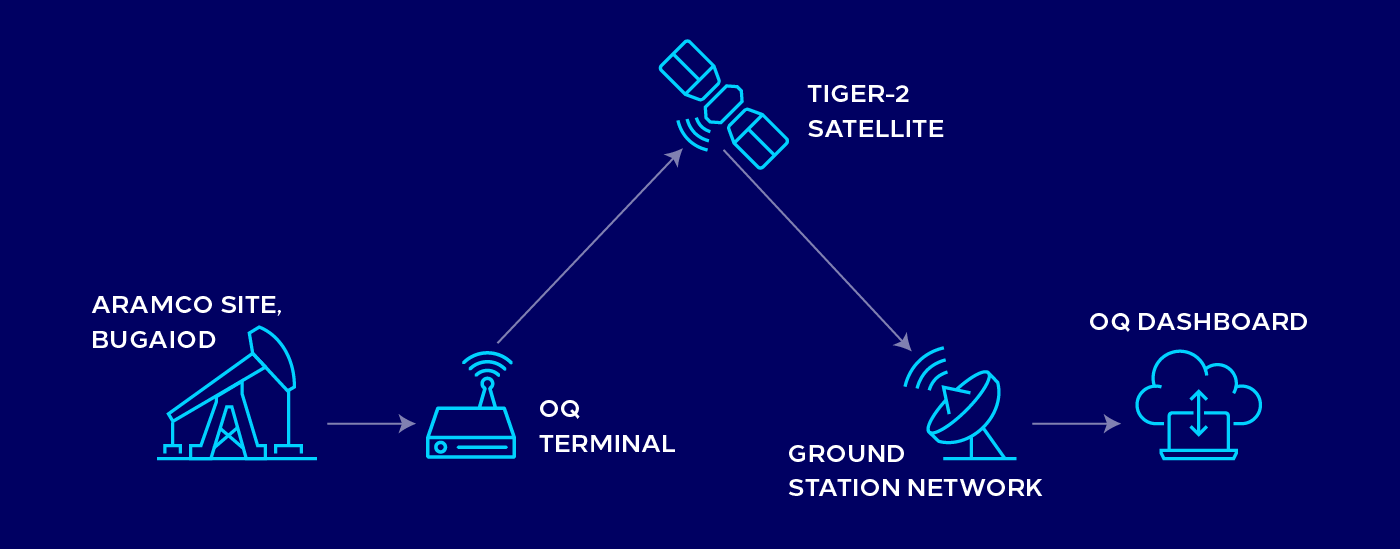
The schematic diagram of the trial is illustrated in the figure, where the field sensor data is interconnected to an OQ TECH terminal through Bluetooth before forwarding the sensed data to the corresponding satellite. The trial setup can be categorized into two main segments, namely Ground and Space, where both can be summarized as follow:
Ground Segment and Space Segment
Ground Segment
Use case defined together with Aramco, meant to represent parameters of vital importance to operations:
- Monitored Parameters: Temperature, Humidity, and CO2.
- Hardware: One OQ TECH terminal interconnected to sensors via Bluetooth, natively supporting GPS positioning.
- Data Logging: Gathers readings every 2 hours and stores them until the next satellite pass.
- Beamwidth: Very large beamwidth to allow connection for virtually any elevation.
- Deployment: No accurate pointing required; the terminal is simply laid on any surface ready to transmit.
Space Segment
- Satellite: Tiger-2, operating at 525 km altitude and 97.5 degrees inclination, using NB-IoT technology.
- Pass Frequency: The satellite passes over the area twice a day.
- Elevation Angles: Typically ranges from 20 to 70 degrees.
- Uplink: Data is transmitted to the satellite instantly as it passes over the site.
- Store & Forward: Data is stored in the satellite until it comes into visibility of the next ground station.
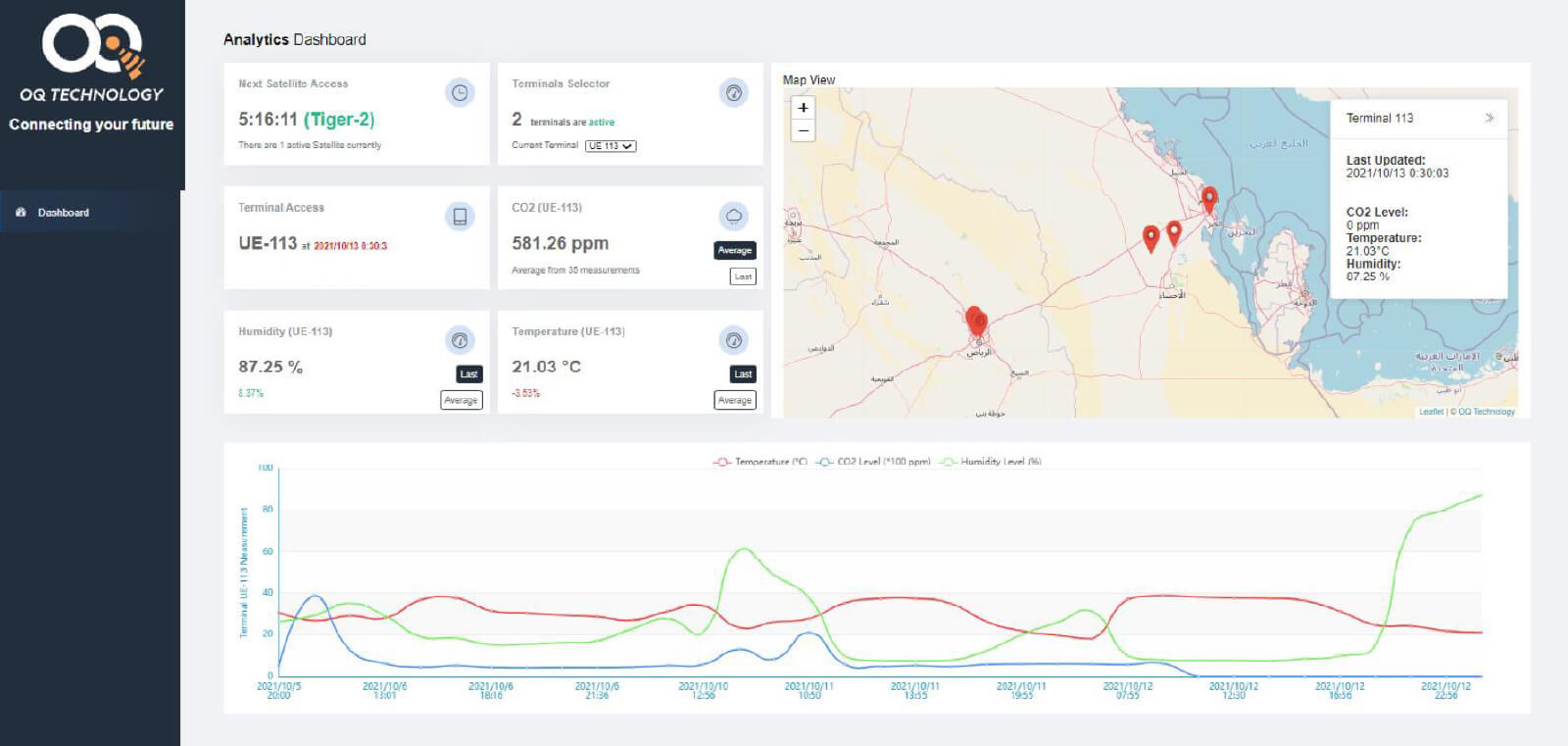
An ultra-high reliability connection was achieved as all the transmitted data frames were successfully received and decoded at the ground station.
The decoded data were then transmitted to the cloud-based dashboard that shown in this Fig.
Additionally, a date throughput of 9.6 Kbps and an overall latency of 10 millisecond (ms) were attained, respectively.
In conclusion, our successful trial has demonstrated that, the LEO-aided 5G -IoT satellite can be used to provide coverage to remote areas in harsh environments.